
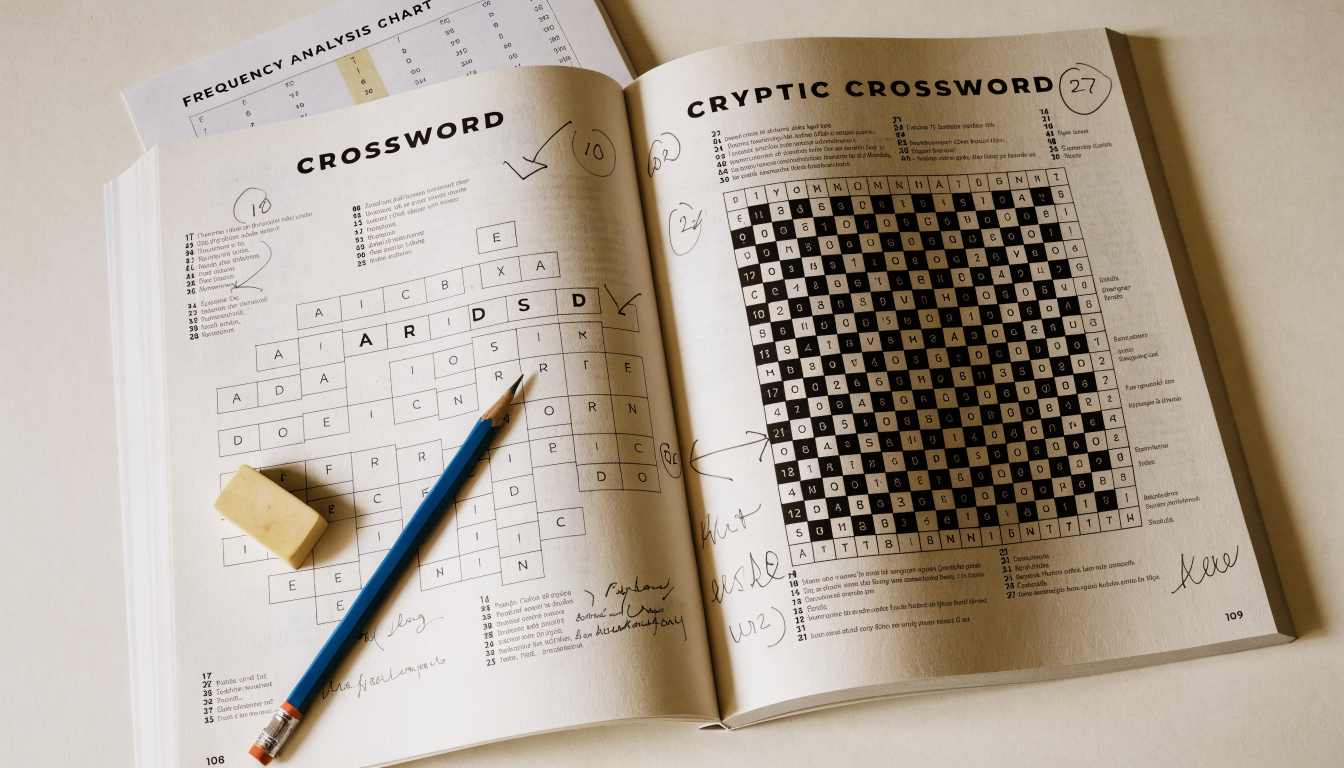
How to Solve a Cryptogram Puzzle
Master the art of cracking coded messages. From beginner-friendly techniques to advanced strategies, this guide gives you everything you need to decode any cryptogram with confidence.
Understanding the Basics of Cryptogram Solving
A cryptogram is a puzzle where each letter in a message has been replaced by a different letter. Your job is to figure out which letter stands for which. Every cryptogram uses a consistent substitution pattern throughout the entire puzzle. Once you crack one letter, it applies everywhere in that message.
Before you start guessing randomly, you should know that experienced solvers rely on logic, language patterns, and letter frequency rather than trial and error. If you are new to these puzzles, our guide on what a cryptogram puzzle is provides essential background knowledge.
The techniques below work for standard substitution ciphers, which are the most common type found in puzzle books for adults and kid-friendly collections. With practice, you will move from hesitant beginner to confident decoder.
Step-by-Step Solving Process
Follow this structured approach to solve any cryptogram efficiently. Each step builds on the previous one, giving you more letters and more confidence as you progress.
Step 1: Scan for Single-Letter Words
The fastest way to begin is by looking for single-letter words. In English, only two words consist of a single letter: "I" and "A". When you spot a standalone letter in the puzzle, it must represent one of these two. If the puzzle contains two different single-letter words, one is "I" and the other is "A."
This simple observation often unlocks several other words immediately. Once you know which coded letter stands for "A," you can scan the rest of the puzzle for every occurrence of that letter.
Step 2: Identify Short Common Words
Two-letter and three-letter words appear frequently in English text. Common two-letter words include "is," "it," "in," "on," "to," "of," "an," and "or." For three-letter words, watch for "the," "and," "for," "are," "but," "not," and "was."
The word "THE" is the most common three-letter word in English. If you see a three-letter pattern repeated multiple times throughout the cryptogram, there is a strong chance it represents "THE." Cracking this single word gives you three letters at once.
Step 3: Use Frequency Analysis
Frequency analysis is the most powerful technique in your solving toolkit. In standard English text, certain letters appear far more often than others. The most frequently used letters, ranked in order, are:
- E — the most common letter, appearing in roughly 13% of all text
- T — the second most frequent, found in about 9% of text
- A, O, I, N, S, H, R — these round out the top ten
Count how often each coded letter appears in the puzzle. The letter that shows up most frequently is very likely E or T. Cross-reference your count with the word patterns you have already identified. This method narrows your options dramatically.
Step 4: Look for Pattern Words and Endings
English words follow predictable patterns. Common word endings include "-ING," "-TION," "-ED," "-ER," "-LY," and "-NESS." If you spot a coded word ending in a three-letter group that repeats across the puzzle, it could be one of these suffixes.
Similarly, look for common beginnings like "UN-," "RE-," "PRE-," and "DIS-." Pattern recognition accelerates your solving speed because each identified suffix or prefix reveals multiple letters at once.
Apostrophes and Double Letters: Hidden Clues
Apostrophes are a puzzle solver's best friend. When you see an apostrophe in a cryptogram, it limits the possibilities enormously. The most common contractions are "N'T," "'S," "'RE," "'VE," "'LL," and "'D."
If a word ends with an apostrophe followed by a single letter, that letter is almost certainly "T" (as in "don't," "can't") or "S" (as in "it's," "that's"). Two letters after an apostrophe usually spell "RE," "VE," or "LL."
Double letters offer another valuable clue. The most common double-letter combinations in English are "LL," "SS," "EE," "OO," "TT," "FF," and "PP." When you find a repeated letter in the coded text, these pairs are your top candidates.
Combining apostrophe clues with double-letter analysis often breaks open an otherwise stubborn puzzle. These structural patterns exist in every language, making them reliable anchors for your solving strategy.
Intermediate Strategies for Faster Solving
Once you have the fundamentals down, these intermediate techniques will help you tackle harder puzzles and solve them more quickly.
Cross-Referencing Across Words
Every letter you decode applies to the entire puzzle. After placing a few letters, scan through every word that contains those letters. Partially decoded words often become obvious. For example, if you know "T," "H," and "E," a word like "_THE_" could quickly reveal itself as "OTHER."
Keep a pencil handy and write possible letters lightly above or below the coded text. Erase and adjust as you gather more evidence. Systematic cross-referencing prevents mistakes and builds momentum.
Vowel and Consonant Distribution
Every English word contains at least one vowel (A, E, I, O, U). Look at longer words and identify which coded letters must be vowels based on their positions. A five-letter word with no vowels among your decoded letters means at least one of the remaining unknown letters is a vowel.
Also consider that Q is almost always followed by U in English. If you identify Q, you immediately know the next letter too. Similarly, certain consonant clusters like "TH," "SH," "CH," and "WH" appear at the beginnings of many words.
Recognizing Sentence Structure
Cryptograms often contain famous quotes, proverbs, or meaningful sentences. As you decode more letters, think about what the overall message might say. Context clues from partially solved phrases can help you guess remaining words.
Pay attention to word length patterns. A short word followed by a long word at the start of a sentence might be "The [something]" or "Every [something]." Your brain is naturally good at filling in gaps when enough context exists.
Advanced Techniques for Expert Solvers
Ready to move beyond the basics? These advanced methods separate casual solvers from true cryptogram enthusiasts.
Digraph and Trigraph Analysis
A digraph is a pair of letters that frequently appear together. The most common English digraphs are "TH," "HE," "IN," "ER," "AN," "RE," and "ON." A trigraph extends this to three-letter combinations: "THE," "AND," "ING," "HER," "HAT," and "HIS."
By mapping the frequency of coded letter pairs and triples, you can match them against known English digraph and trigraph frequencies. This statistical approach is especially effective for longer cryptograms where patterns become more reliable.
Elimination and Logical Deduction
In a substitution cipher, no letter can represent itself, and each letter maps to exactly one other letter. Use elimination to rule out impossible assignments. If you know that coded letter "X" represents "E," then "X" cannot represent any other letter, and no other coded letter can represent "E."
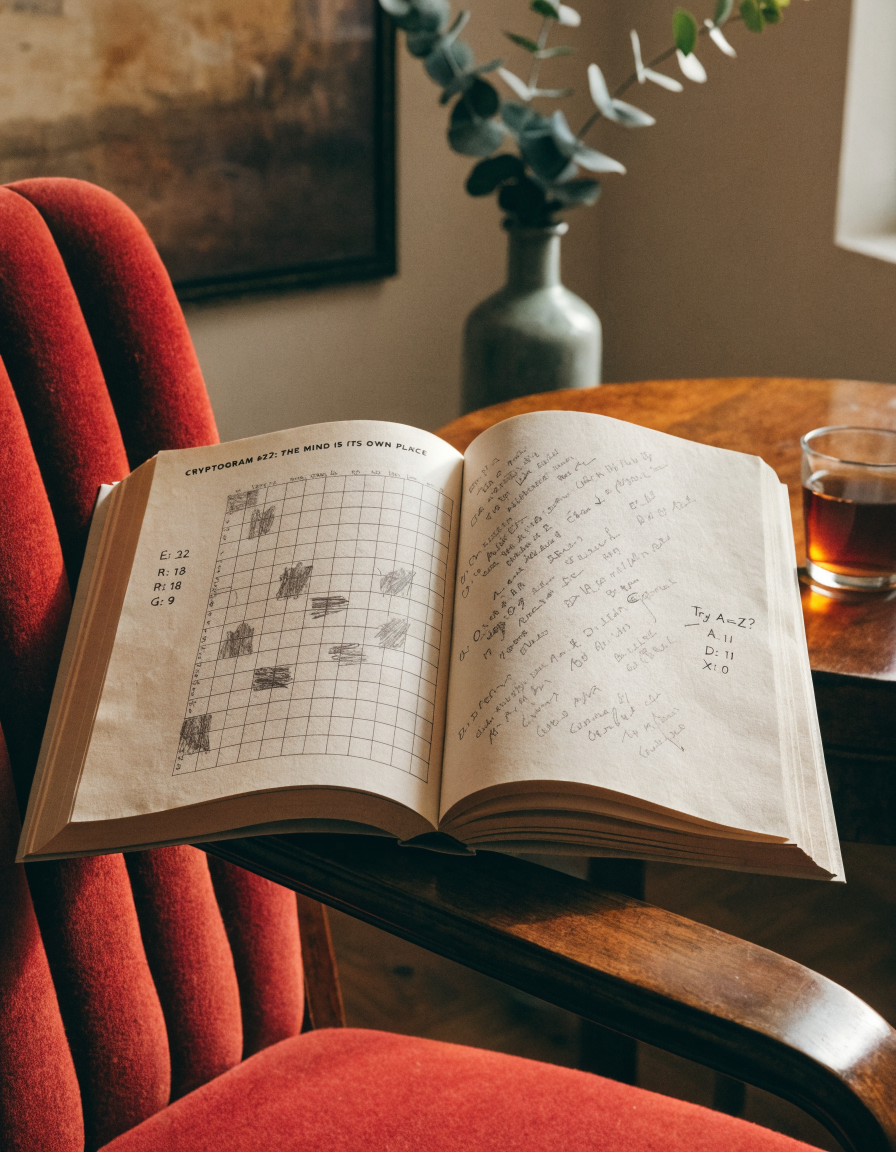
Maintain a tracking grid with all 26 letters along the top and side. Mark confirmed pairs and cross out eliminated options. This systematic approach prevents contradictions and ensures logical consistency.
Working Backwards from Partial Solutions
When you are stuck, try a different approach. Pick a word where you know several letters but not all. List every possible English word that fits the pattern. Then test each candidate by applying its new letters throughout the puzzle.
If a candidate creates impossible letter combinations elsewhere, eliminate it. If it unlocks new words and patterns, you have found the right answer. This hypothesis-testing method is how professional codebreakers approach difficult ciphers.
Common Mistakes to Avoid
Even experienced solvers fall into traps. Awareness of these common pitfalls will save you time and frustration.
- Guessing too early: Placing letters based on gut feeling rather than evidence creates cascading errors. Always verify a letter in multiple positions before committing.
- Ignoring word boundaries: Focus on complete words rather than individual letters in isolation. A letter only makes sense within the context of real English words.
- Forgetting the one-to-one rule: Each coded letter represents exactly one plaintext letter and vice versa. Accidentally assigning two meanings to one letter will derail your solution.
- Skipping frequency analysis: Jumping straight to guesswork without counting letter frequencies throws away your most powerful tool.
- Not using pencil: Writing in pen means you cannot easily correct mistakes. Always use a pencil with a good eraser so you can adjust as you learn more.
- Overlooking punctuation: Commas, periods, and apostrophes are not encoded. They appear as themselves and provide valuable structural clues.
Practice Recommendations
Improvement comes with consistent practice. Start with shorter puzzles that use common words and gradually work your way up to longer, more complex cryptograms. Our kids' cryptogram books are perfect for absolute beginners, while adult collections offer a satisfying challenge for intermediate and advanced solvers.
Set a goal of solving one cryptogram per day. Daily practice strengthens your pattern recognition skills and builds a mental library of common word structures. Within a few weeks, you will notice a dramatic improvement in both speed and accuracy.
Keep a log of your solving times. Tracking your progress is motivating and helps you identify which techniques work best for you. Many solvers find that a combination of frequency analysis and pattern recognition yields the fastest results.
Ready to put your skills to the test? Browse our collection and find the perfect challenge at our bookstore page. Whether you prefer printed books or digital puzzles, regular practice is the single best way to become a confident cryptogram solver.
Ready to Put Your Skills to the Test?
Browse our curated collection of cryptogram puzzle books for every skill level. From gentle beginner puzzles to brain-bending expert challenges.
Browse Our Collection